PID & perimeter security
Secure remote monitoring for PID systems
TrackSyte® provides secure remote asset monitoring for PID and perimeter intrusion detection deployments — connectivity, device status and site health when the panel is miles away. One gateway. CAN, Modbus, RS485, Ethernet, LTE — into one monitoring stack, so exceptions reach TrackSyte® Portal before someone rolls a van.
This monitors the security asset and system stack remotely; it does not replace the PID manufacturer’s panel. For UK security managers, hire fleets and perimeter operators, the value is knowing whether the stack is reachable and healthy — then deciding whether a visit is justified. GNSS is fitted as standard on Neo 2 — a full-constellation GPS/GNSS receiver that can support tracking and GPS-related functions alongside the gateway and Portal monitoring stack.
The cost of blind PID and perimeter sites
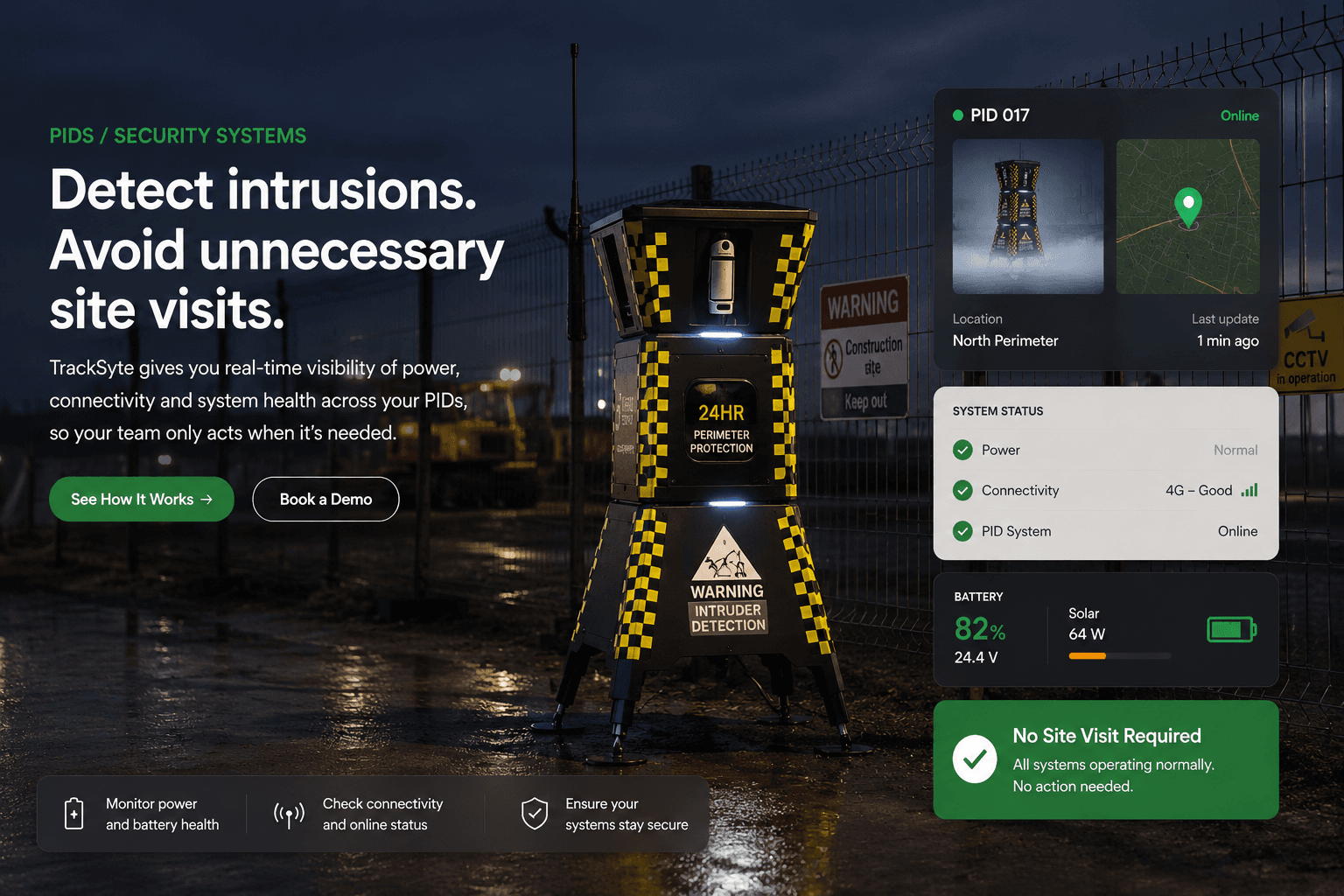
Offline panels, unanswered faults and silent link failures still drive truck rolls across UK temporary sites, construction compounds and critical perimeters. When a fence zone or controller drops off the network, the first sign is often a frustrated call from site — not a clean alert in ops. By then someone is already in a van, and the fault may turn out to be power, SIM health or a simple connectivity drop rather than a detection failure.
That pattern is familiar to security managers and hire fleets: temporary kits that move weekly, remote estates with thin staff cover, and perimeters that matter most when nobody is looking. Blind PID sites cost more than parts; they cost time, overtime and eroded trust that “the system is watching.” Site teams also lose confidence when every outage looks the same from the office — panel problem, power problem or network problem all feel identical until someone arrives.
Remote monitoring of power, connectivity and status closes that gap without pretending TrackSyte is the intrusion product itself. We connect and surface the asset stack; the manufacturer’s PID logic and ARC relationship stay where they belong.
What remote monitoring covers
Honest scope: device, link and site status in Portal — the operational picture that tells you whether the stack is alive and reachable. Alerting prioritises real faults so teams despatch on exceptions, not routines. We do not claim camera analytics, ARC replacement or manufacturer-panel features we do not ship. If the job on a given compound is mainly towers, see the sibling CCTV tower monitoring page; this sector stays focused on PID and perimeter intrusion assets.
Where visit cost dominates the business case, pair this page with commercial impact and the site visit calculator. The ROI story is fewer unnecessary call-outs and faster confirmation that a fault is worth attending. TrackSyte’s Cornwall base and UK field focus are covered on About — EEAT through real operating context, not invented badges.
How Neo 2 and integrations fit PID sites
One gateway. CAN, Modbus, RS485, Ethernet, LTE — into one monitoring stack. On PID sites the protocols that typically matter are LTE-M / NB-IoT, Ethernet, GPIO, and Modbus where the field device speaks it — with RS485 available on Neo 2 when the perimeter edge needs a serial field bus.
Neo 2 is the gateway that brings those interfaces into TrackSyte’s monitoring stack and on to Portal via MQTT / API. Neo 2 also ships with a 12V supply and Bluetooth; power-side conversations (Victron, smart/lithium BMS, Smart Shunt) apply where that kit sits alongside the intrusion stack. The supporting line is deliberate: one gateway path into one monitoring stack, not a scatter of single-purpose boxes.
Security-system integrations such as Ajax sit alongside the gateway where that stack is in play. For Hub and broader family depth, see Hardware & integrations — without treating Hub as the exclusive RS485 path. GNSS is fitted as standard on Neo 2 — a full-constellation GPS/GNSS receiver that can support tracking and GPS-related functions. We name only approved integrations and interfaces; we do not invent PID brand partnerships beyond what is already true on the site.
- LTE-M / NB-IoT cellular options (Neo 2)
- Ethernet connectivity (Neo 2)
- GPIO and Modbus connectivity where relevant (Neo 2)
- RS485 connectivity when the edge needs it (Neo 2)
- 12V supply and Bluetooth (Neo 2)
- Victron / smart-lithium BMS / Smart Shunt where power kit sits alongside the intrusion stack
- GNSS fitted as standard — full-constellation GPS/GNSS that can support tracking and GPS-related functions
Typical setups
Fixed perimeter PID on a remote site. A permanent or long-stay perimeter with thin on-site cover needs link and status visibility first. Neo 2 backhauls Ethernet or cellular into Portal so faults surface before a night call-out becomes default. Ops can see whether the site is dark on communications before treating every alarm as a detection event.
Temporary construction-site intrusion kit. Hire and pop-up kits move often and lose power or SIM health in the process. Remote alerts cut the “is it even powered?” visit before anyone assumes the PID itself has failed. Temporary sites are where blind stacks cost the most relative to hire revenue.
Mixed PID + CCTV tower compound. Many UK sites run intrusion detection next to mobile towers. Cross-link CCTV tower monitoring for the tower asset story; keep PID monitoring focused on the intrusion stack under the same Portal. Shared visibility reduces duplicated truck rolls when both asset types sit on one compound.
Multi-site security estate under one Portal. Estates and regional fleets need one operational view across sites — which links are healthy, which panels need attention, which can wait until morning. Exception-based despatch scales better than a standing rota of check visits across a scattered estate.
- Fixed perimeter PID on a remote site
- Temporary construction-site intrusion kit
- Mixed PID + CCTV tower compound
- Multi-site security estate under one Portal
Security — physical and cyber
Physical. PID, towers and perimeter context are the job: knowing whether remote security assets are reachable and healthy supports the people who own the fence line and the ARC relationship. TrackSyte connects and monitors; it does not replace the PID panel or the manufacturer’s detection logic. Physical security remains site design, detection and response — remote monitoring keeps the supporting stack honest.
Cyber. Authentication, TLS, certificates and MQTT protect the data path into Portal. We state those basics and stop there — no invented ISO, SOC or compliance badges. Trust comes from clear scope and named interfaces, not seals we have not earned on this page.
Related capabilities and hardware
FAQs
Does TrackSyte replace a PID manufacturer’s panel?
No. TrackSyte® monitors and connects remote PID / perimeter assets into the Portal. It does not replace the manufacturer’s intrusion detection panel or ARC relationship.
Does Neo 2 include GPS / GNSS?
Yes. GNSS is fitted as standard on Neo 2: a full-constellation receiver that can support tracking and GPS-related functions, alongside the gateway and Portal monitoring stack for PID and perimeter assets.
Does Neo 2 support RS485 for perimeter sites?
Yes. RS485 is available on Neo 2 when the edge needs a serial field bus, alongside CAN, Modbus, GPIO, LTE-M / NB-IoT, Ethernet, 12V supply and Bluetooth. Hub remains available in the hardware family for other edge stories — RS485 is not exclusive to Hub. See /hardware/neo-2 and /hardware-integrations.
Which protocols matter most on PID sites?
Typically LTE-M / NB-IoT, Ethernet, GPIO and Modbus where the field device speaks it — with RS485 when the perimeter edge needs a serial field bus. Neo 2 brings those into Portal via MQTT / API, with 12V supply and Bluetooth for power-side kit where present.
See PID monitoring on a demo
Ready to see secure remote asset monitoring on a PID-style site? Book a demo. We cover Neo 2 interfaces that fit perimeter kit (including RS485 where relevant), Portal alerts and how status visibility changes visit decisions.