Vibration monitoring · shock · running hours · condition
Remote vibration monitoring for plant, machinery and site equipment
TrackSyte® Neo 2 has a built-in accelerometer, so every connected asset can report vibration as well as power, location and status. Get alerts for knocks and impacts, log running hours from vibration alone, track vibration levels against thresholds and spot developing faults — without fitting a separate sensor system.
Vibration data reaches the TrackSyte Portal over LTE, LTE-M or NB-IoT alongside everything else Neo 2 reads over CAN bus, RS485 / Modbus, GPIO and Ethernet, so one device and one portal cover monitoring, tracking and vibration.
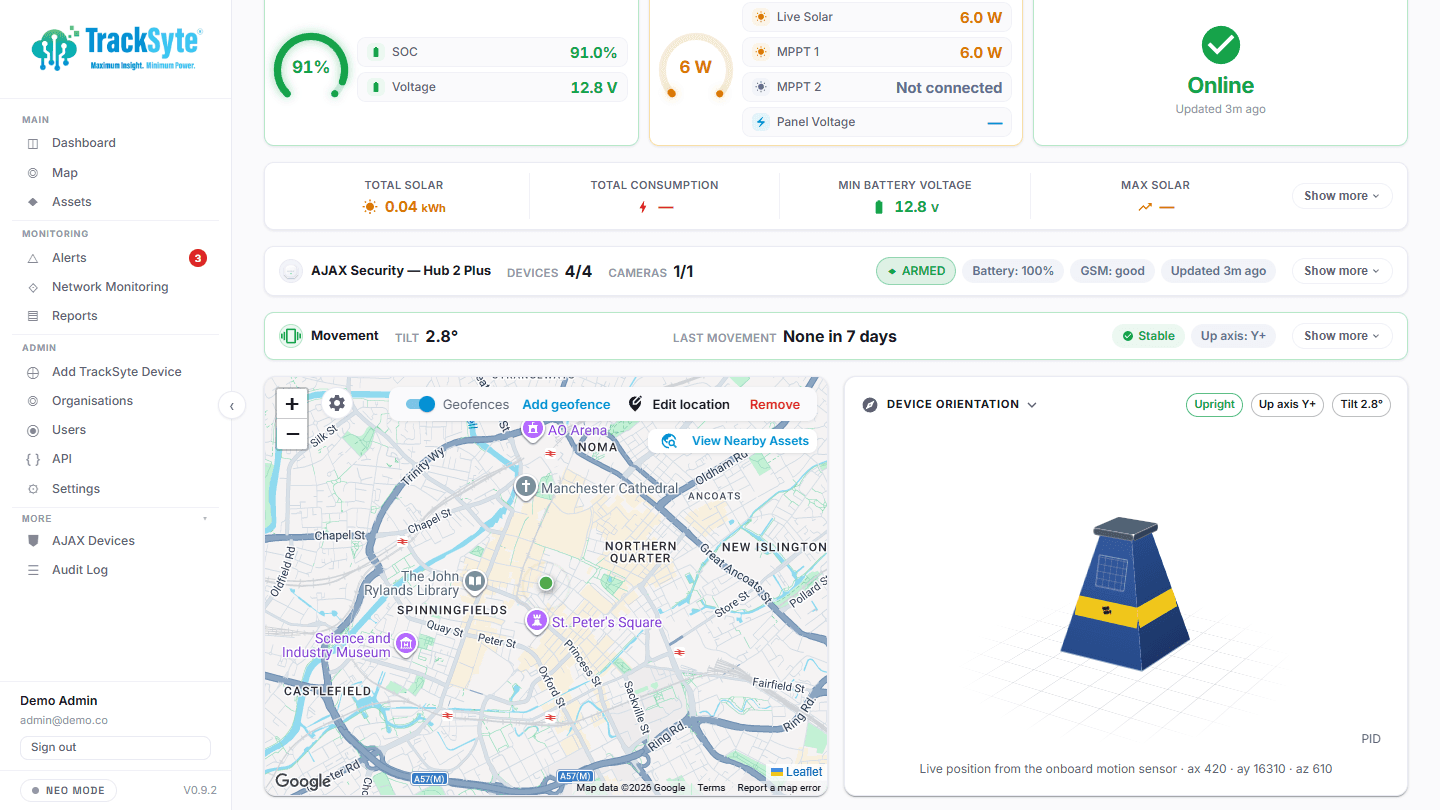
What Neo 2 measures with its accelerometer
An accelerometer measures movement and vibration in three directions. Neo 2 uses it in four ways, from simple alerts to condition monitoring.
| Use | What it tells you | Typical assets |
|---|---|---|
| Shock and impact alerts | An asset has been knocked, struck, dropped or tampered with | CCTV towers, welfare units, generators, plant |
| Running detection and hours | Whether a machine is running, and for how long — no ignition wire needed | Older plant, compressors, pumps, generators |
| Vibration levels and thresholds | Regular vibration readings, with an alert when a limit is crossed | Pumps, generators, fans, construction sites |
| Vibration analysis | Changes in the vibration pattern that point to wear, imbalance or bearing problems | Motors, pumps, generators, rotating plant |
Shock and impact alerts
A knocked CCTV tower, a welfare unit hit by a telehandler or a generator being loaded onto a lorry all produce a sharp spike in acceleration. Neo 2 detects it and raises an alert in the Portal, alongside tilt and movement detection and the asset's GNSS location, so you know what happened, where and when.
That helps with damage disputes, theft attempts and knowing when a tower needs re-levelling — without waiting for someone to notice on the next visit.
Running hours from vibration — no ignition wire
Many older machines have no telematics and no convenient ignition signal. A running engine or motor vibrates in a way a stationary one does not, so Neo 2 can tell when a machine is working and log running hours from vibration alone.
That gives hire companies and contractors utilisation and service hours for plant that would otherwise need manual hour-meter readings, and works alongside CAN bus engine hours on newer machines.
Vibration levels and alert thresholds
Neo 2 can report vibration levels at regular intervals, building a history in the Portal. Set a threshold and TrackSyte alerts you by email, webhook or Slack when it is crossed — for example when a pump starts running rough or a generator's vibration climbs above its normal range.
Because the readings sit next to power, fuel, battery and alarm data from the same asset, it is easier to tell a mechanical problem from an electrical or supply fault before sending an engineer.
Vibration analysis and condition monitoring
Most mechanical faults change a machine's vibration before they cause a breakdown. Imbalance, misalignment, looseness and bearing wear each leave a signature. Neo 2 can analyse vibration to pick up those changes, supporting condition monitoring and predictive maintenance on motors, pumps, generators and other rotating plant.
The aim is simple: repair on your schedule, not after a failure on a remote site. Combined with running hours, it lets you plan servicing on how hard each machine has actually worked.
- Spot developing faults before a breakdown
- Plan maintenance on condition and actual running hours
- Compare machines of the same type across the fleet
- Keep vibration history alongside alerts and service records
One device instead of a separate vibration system
Dedicated wireless vibration sensors usually need their own gateway, platform and subscription. Neo 2 already sits on the asset for power, location and machine data, so vibration monitoring comes from the same unit and appears in the same TrackSyte Portal as the rest of your fleet.
| Standalone vibration sensor | TrackSyte Neo 2 | |
|---|---|---|
| Vibration and shock | Yes | Yes — built-in accelerometer |
| Running hours | Sometimes | Yes — from vibration or CAN bus |
| Location | Rarely | Yes — full-constellation GNSS |
| Power, battery and machine data | No | Yes — CAN bus, RS485 / Modbus, GPIO, Victron, BMS |
| Connectivity | Often needs its own gateway | LTE, LTE-M, NB-IoT or Ethernet built in |
FAQs
What is vibration monitoring?
Vibration monitoring uses a sensor, usually an accelerometer, to measure how a machine or structure is moving. Changes in vibration show knocks and impacts, whether a machine is running, and developing mechanical faults such as imbalance or bearing wear.
Does Neo 2 have a vibration sensor?
Yes. Neo 2 has a built-in accelerometer that measures vibration, shock, tilt and movement, so no separate vibration sensor is needed for most uses.
Can it log running hours without an ignition wire?
Yes. Neo 2 can detect that a machine is running from its vibration and log running hours, which is useful for older plant with no telematics or ignition signal.
Can I set vibration alerts?
Yes. Neo 2 reports vibration levels to the TrackSyte Portal, and you can set thresholds that trigger alerts by email, webhook or Slack.
Is this condition monitoring?
Yes. Neo 2 can analyse vibration to spot changes that point to wear, imbalance or bearing problems, supporting condition monitoring and predictive maintenance on motors, pumps, generators and rotating plant.
What else does Neo 2 monitor?
Alongside vibration, Neo 2 reads CAN bus, RS485 / Modbus, GPIO and Ethernet equipment, works with Victron, BMS batteries and EFOY fuel cells, and has full-constellation GNSS for location.
See vibration monitoring in a demo
Book a demo to see shock alerts, running hours and vibration trends from Neo 2 alongside power, location and status in the TrackSyte Portal.