Field hardware
TrackSyte Neo 2 — multi-protocol gateway for remote asset monitoring
One gateway. CAN, Modbus, RS485, Ethernet and cellular — into one monitoring platform.
Neo 2 is TrackSyte's multi-protocol industrial IoT gateway. It fits to remote plant, CCTV towers, power systems and industrial assets, brings their data together in one place and sends it to the TrackSyte® Portal, so UK teams act on real faults rather than routine checks. It does everything the original Neo does, and adds Ethernet, RS485, CAN bus, a 9–30 V DC supply and Bluetooth.
What Neo 2 is
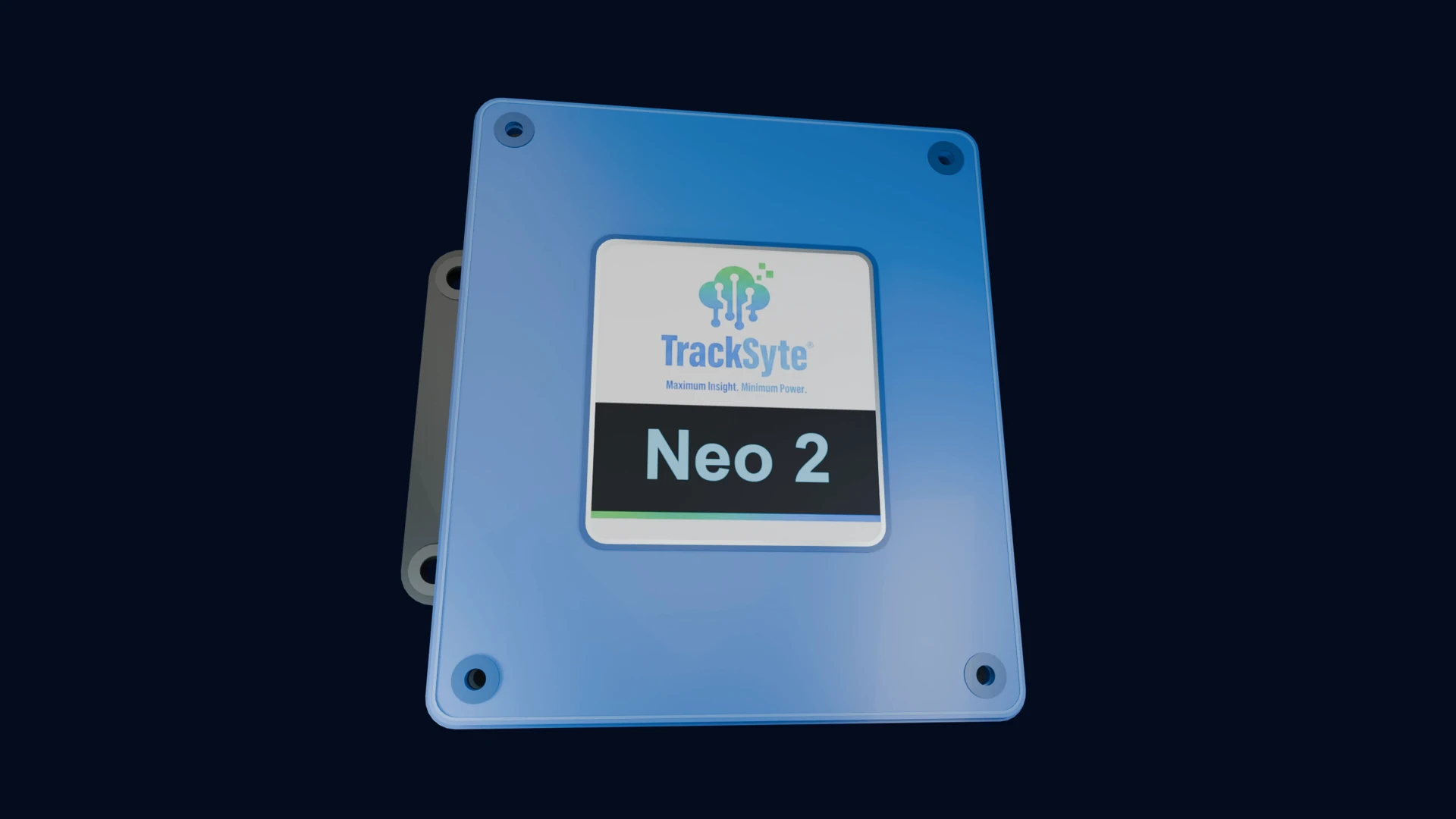
Neo 2 is a field gateway for remote asset monitoring. It connects to the equipment you already run — machine networks, serial controllers, discrete IO and networked devices — and sends operational data securely to the TrackSyte® Portal.
It supports everything the original Neo does, and is fitted with Ethernet, RS485, CAN bus and a 9–30 V DC supply, plus Bluetooth for nearby power and battery equipment.
In telematics terms, Neo 2 is a telematics control unit (TCU) for industrial equipment: the on-board unit that reads the asset's systems, works out its position by satellite and sends the data over a cellular network — built for plant, towers, generators and pumps rather than cars.
Neo 2 also works as a remote data logger. Every reading it takes is sent to the TrackSyte® Portal and kept as history, so you can chart battery, power, running and machine data over time and export it as CSV — without anyone visiting site to download a logger.
A built-in lithium backup battery keeps Neo 2 reporting if the asset's own power is lost or disconnected, so a flat battery, a cut supply or a stolen asset does not leave you blind. It recharges from the asset's supply and gives a couple of days of reporting on its own, depending on how often Neo 2 is set to send updates.
TrackSyte is built and supported by Green Power Solutions in Cornwall, with hardware designed for UK towers, hire plant, temporary power and perimeter sites.
A multi-constellation GNSS receiver (GPS, Galileo, GLONASS and BeiDou) is fitted as standard, with Wi-Fi positioning as a fallback when there is no satellite fix.
Neo 2 is built for low power: consumption is as low as 0.013 W, and its SIM is valid for five years. You choose how often it reports — in real time, every 60 seconds, every 15 minutes or at a longer interval.
Neo 2 is not a PID panel, a camera system or a replacement for manufacturer controllers — it connects to and monitors the equipment you already use.
Connectivity at a glance
Reads equipment over CAN bus (CAN 2.0A/B, CAN FD, SAE J1939) · RS485 / Modbus RTU · Digital inputs and outputs · Bluetooth / BLE · UART / USB serial, VE.Direct.
Connects over 4G LTE, LTE-M and NB-IoT cellular · 10/100 Ethernet · 2.4 GHz Wi-Fi, sending data to the Portal by MQTT over TLS and HTTPS / REST API.
Neo 2 also works with Victron equipment, smart/lithium BMS batteries and Smart Shunt where that kit is on site. To compare Neo 2 with TrackSyte Hub and the original Neo, see Hardware & integrations.
- 9–30 V DC supply
- Power draw as low as 0.013 W
- SIM valid for five years
- Lithium backup battery
- 6-axis IMU (accelerometer and gyroscope)
- GNSS: GPS, Galileo, GLONASS, BeiDou
- FCC certified
Designed for
Neo 2 is built for the same remote fleets TrackSyte already serves — and for plant networks that need a proper field gateway.
- CCTV tower monitoring
- PID / perimeter monitoring
- Construction equipment telematics
- Pump and sump monitoring
- Hybrid and temporary power
- Construction fleet monitoring
Neo 2 specification: communications and protocols
Every interface and protocol on Neo 2, and what it is used for. To compare Neo 2 with Hub and the original Neo, see Hardware & integrations.
| Category | Interface / protocol | Notes |
|---|---|---|
| Cellular | 4G LTE / LTE-M / NB-IoT | Remote IP connectivity; SIM valid for five years |
| Ethernet | 10/100 Ethernet | Wired LAN or industrial network; connects to an existing router |
| Wi-Fi | 2.4 GHz Wi-Fi | Local or network connectivity, and Wi-Fi positioning when there is no GNSS fix |
| Bluetooth | Bluetooth / BLE | Peripheral sensors and device integration |
| GNSS | GPS, Galileo, GLONASS, BeiDou | Multi-constellation positioning |
| CAN bus | CAN 2.0A / CAN 2.0B | Standard and extended CAN identifiers, up to 1 Mbps, 8-byte payload |
| CAN FD | CAN FD | Newer CAN with a higher data rate and up to 64-byte payload |
| Vehicle / machine CAN | SAE J1939 | Engines, construction plant, agriculture, generators and commercial vehicles |
| Diagnostics | ISO 15765-4 CAN / ISO-TP | Where automotive diagnostic communication is required |
| RS485 | RS485 serial | Industrial field devices |
| Modbus | Modbus RTU | Meters, BMS, PLCs, generators and sensors |
| Serial | UART / USB serial, VE.Direct | Configuration, service and peripherals, including Victron over VE.Direct |
| GPIO | Digital inputs / outputs | Volt-free contacts, alarms, switches and control |
| Sensors | 6-axis IMU (accelerometer and gyroscope) | Movement, tilt, rotation, shock, impact and vibration |
| MQTT | MQTT / MQTT over TLS | Primary IoT telemetry and command protocol |
| HTTP/S | HTTP / HTTPS REST APIs | Cloud and API integration, provisioning and configuration |
| Security | TLS / X.509 certificates | Individual device authentication and encrypted communications |
| Remote management | OTA firmware updates | Secure remote firmware and software management |
| Reporting | Configurable intervals | Real time, every 60 seconds, every 15 minutes or longer |
| Power | 9–30 V DC supply | Consumption as low as 0.013 W; built-in lithium backup battery |
| Certification | FCC | Certified for use in the United States |
CAN bus for plant and vehicles
CAN bus opens up plant and vehicle networks — excavators, dumpers and other machines — that Ethernet-only gateways cannot read. For plant hire companies and contractors, that means machine data in the same Portal as towers, power and pumps.
The CAN bus capability page explains how it works, and construction equipment telematics and construction fleet monitoring show it in use.
Works with TrackSyte Portal
Neo 2 is the field gateway; the TrackSyte® Portal is the remote asset monitoring software. Status, alerts and operational data arrive securely over MQTT, so operations teams, hire desks and security managers share one view — and engineers are sent to real faults, not routine checks.
Customers can use their data in three ways: in the TrackSyte® Portal, through the TrackSyte API in their own software and dashboards, or — by special request — through controlled, certificate-based access to the TrackSyte® MQTT broker with defined topic permissions.
To see what that means in money and time saved, visit commercial impact or try the site visit calculator.
Integrations
Neo 2 and the Portal work with TrackSyte's integrations for power, security and data.
Neo 2 works with Victron power systems, smart and lithium batteries with a BMS, and Smart Shunt for battery monitoring. Power customers often start with Victron or EFOY, security customers add Ajax, and custom estates use the API. Each integration page has the details.
Security
Physical. Neo 2 is designed for towers, PID sites, plant and temporary power — remote assets where someone has to decide whether to drive out. It supports those assets alongside your existing detection and response systems.
Cyber. Every Neo 2 has its own X.509 device certificate and talks to the TrackSyte® MQTT broker over TLS, so each device is individually authenticated and all communications are encrypted. Firmware is updated securely over the air.
Neo 2, Neo and Hub compared
Neo 2 is the multi-protocol field gateway: CAN, J1939, Modbus, GPIO and RS485 inputs, 4G LTE / LTE-M / NB-IoT, Ethernet and Wi-Fi connectivity, Bluetooth and a 9–30 V DC supply.
Hub is an Ethernet-connected site gateway, and also supports RS485. The original Neo provides ultra-low-power LTE Cat 1 bis connectivity for remote and mobile assets.
The right choice depends on the asset and the site. Hardware & integrations compares the full range.
FAQs
Is Neo 2 a multi-protocol industrial IoT gateway?
Yes. Neo 2 connects CAN bus (including J1939), Modbus, RS485, GPIO and Bluetooth equipment and sends the data over 4G LTE, LTE-M, NB-IoT, Ethernet or Wi-Fi into the TrackSyte® Portal via MQTT. It also has multi-constellation GNSS, a 6-axis IMU and a 9–30 V DC supply.
What power supply does Neo 2 need, and how much power does it use?
Neo 2 runs from any 9–30 V DC supply, so it suits both 12V and 24V assets. Power consumption is as low as 0.013 W, and a built-in lithium backup battery keeps it reporting if the asset's supply is lost.
How long does the Neo 2 SIM last?
The SIM in Neo 2 is valid for five years.
How often does Neo 2 send updates?
You choose. Neo 2 can report in real time or at a set interval, such as every 60 seconds or every 15 minutes. Longer intervals use less power and data.
Does Neo 2 support CAN FD?
Yes. Neo 2 supports CAN FD, with its higher data rate and payloads of up to 64 bytes, as well as classic CAN 2.0A and CAN 2.0B (standard and extended identifiers, up to 1 Mbps). SAE J1939 and ISO 15765-4 diagnostics run over CAN, covering engines, plant, generators and commercial vehicles.
Can I get Neo 2 data into my own systems?
Yes. As well as the TrackSyte® Portal, you can pull data into your own software through the TrackSyte API. By special request, customers can also be given controlled, certificate-based access to the TrackSyte® MQTT broker.
Is Neo 2 a telematics control unit (TCU)?
Yes. Neo 2 is an industrial telematics control unit: it reads CAN bus, RS485 / Modbus, GPIO and Ethernet data from the asset, adds full-constellation GNSS location and sends it over LTE, LTE-M or NB-IoT to the TrackSyte® Portal. It is retrofitted to plant and site equipment rather than built into a car.
Does Neo 2 monitor vibration?
Yes. Neo 2 has a built-in 6-axis IMU for shock and impact alerts, running detection and running hours, vibration levels with alert thresholds, and vibration analysis for condition monitoring. See vibration monitoring for details.
Can Neo 2 be used as a remote data logger?
Yes. Neo 2 sends its readings — battery, power, running hours, machine and controller data — to the TrackSyte® Portal, which keeps the history. You can view historical charts and export the data as CSV, without visiting site to download a logger.
Does Neo 2 have a backup battery?
Yes. Neo 2 has a built-in lithium backup battery, so it keeps reporting status and location if the asset's own power supply is lost, disconnected or tampered with. The battery recharges from the asset's supply and lasts a couple of days on its own — longer if updates are sent less often.
Where is Neo 2 used?
On CCTV towers, PID and perimeter systems, pumps and sumps, hybrid and temporary power, construction sites and construction plant. Each sector page explains how Neo 2 is used there.
Is Neo 2 FCC certified?
Yes. Neo 2 is FCC certified for use in the United States.
Does Neo 2 have RS485?
Yes. RS485 is fitted on Neo 2. It is also available on TrackSyte Hub.
Does Neo 2 support tracking and GPS functions?
Yes. A multi-constellation GNSS receiver (GPS, Galileo, GLONASS and BeiDou) is fitted as standard, and Neo 2 falls back to Wi-Fi positioning when there is no satellite fix.
How does Neo 2 differ from Hub?
Neo 2 is the multi-protocol field gateway with CAN, Modbus, GPIO, RS485, Ethernet, cellular, a 9–30 V DC supply, Bluetooth and GNSS. Hub is an Ethernet-connected site gateway that also supports RS485. See Hardware & integrations to compare them.
Does Neo 2 work with Victron, BMS batteries and Smart Shunt?
Yes, where that equipment is on site. See the Victron integration for details.
How does Neo 2 send data to the Portal?
Over MQTT secured with TLS and an individual X.509 certificate for each device. Operations teams, hire desks and security managers then share one view of every connected asset in the Portal.
How can I see Neo 2 in action?
Book a demo and tell us which assets you want to connect. We will show you Neo 2 and the TrackSyte Portal working together.
Ready to connect your assets with Neo 2?
Book a demo and we will map CAN, Modbus, GPIO, RS485, Ethernet, cellular, Bluetooth and Victron / BMS / Smart Shunt options to your assets.