Battery monitoring · 12V · off-grid
Remote battery monitoring system for off-grid and mobile assets
A battery monitoring system measures a battery's state of charge, voltage and current so you know how much energy is left and whether it is charging properly. TrackSyte® makes that remote: battery data from every CCTV tower, PID system, welfare unit and hybrid power unit reaches one portal, with alerts before a battery runs flat.
Neo 2 runs from the asset's 12V supply and works with Victron equipment, the Victron Smart Shunt and smart lithium batteries with a BMS, sending readings over LTE, LTE-M or NB-IoT cellular.
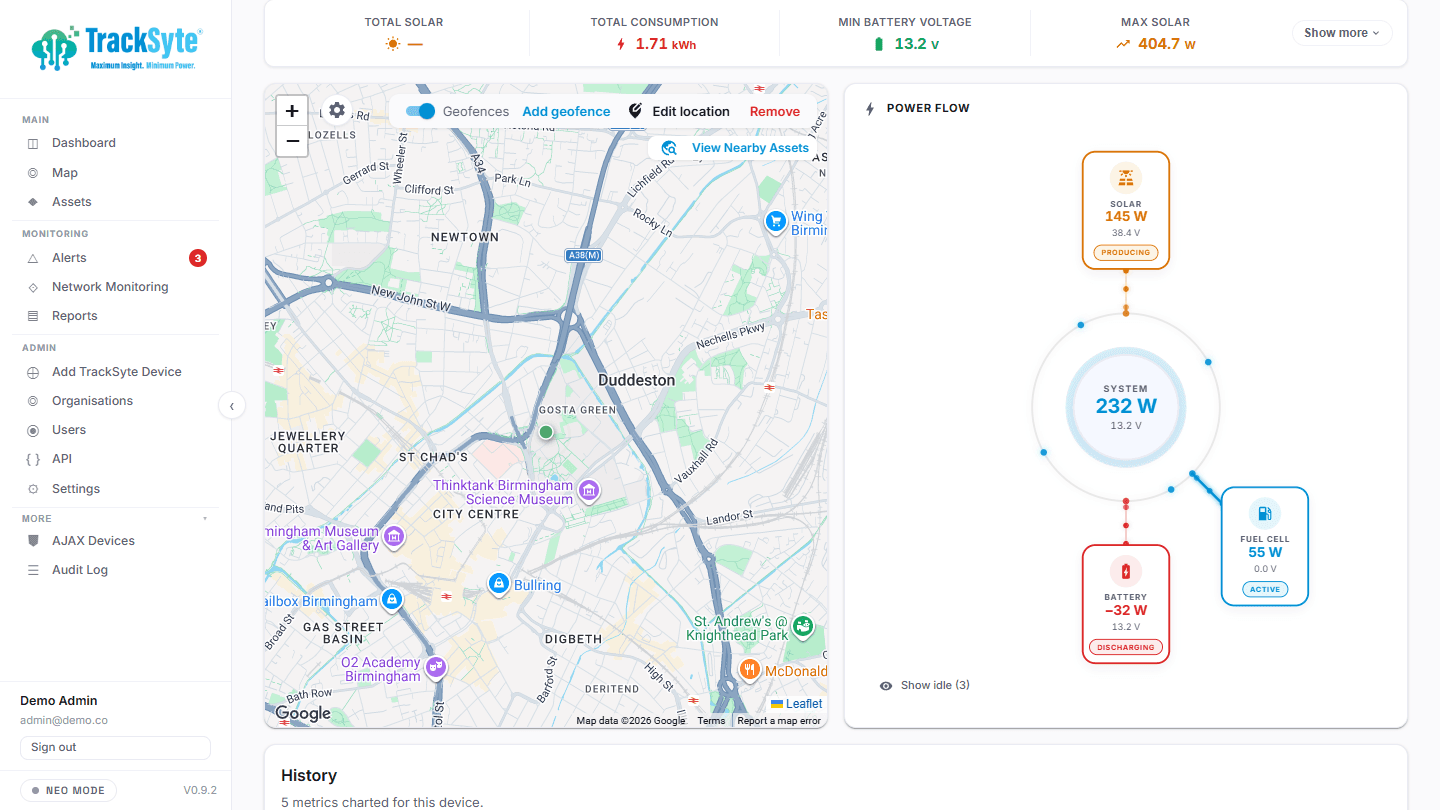
What a battery monitoring system measures
Voltage alone is a poor guide to how much charge a battery has left, especially with lithium batteries whose voltage stays almost flat until they are nearly empty. A proper battery monitoring system measures the current flowing in and out and counts it over time, giving a much more reliable state of charge.
| Reading | What it tells you |
|---|---|
| State of charge (%) | How much usable energy is left in the battery bank |
| Voltage | Battery condition and a cross-check on state of charge |
| Current (A) | Whether the battery is charging or discharging, and how fast |
| Power (W) | How much the load is drawing right now |
| Estimated runtime | How long until the battery is flat at the current load |
| Charging source | Whether solar, a fuel cell or a generator is keeping up |
Shunt-based state of charge with Victron Smart Shunt
A battery shunt sits in the negative cable and measures every amp going in and out of the battery. The Victron Smart Shunt is a common example on off-grid equipment, and it is what gives an accurate state of charge on lead-acid and lithium banks that do not have their own electronics.
Neo 2 reads the Smart Shunt and other Victron equipment on the asset and sends state of charge, voltage, current and runtime to the TrackSyte Portal, so you get the same numbers you would see standing next to the kit, for every site at once.
Smart lithium batteries and BMS data
Many newer towers and power units use smart lithium batteries with a built-in battery management system (BMS). The BMS already knows the state of charge, cell voltages, temperature and any protection events, such as the battery switching itself off because it is too cold to charge or too flat to discharge.
Neo 2 works with supported smart lithium BMS batteries, bringing that data into the same portal as Victron systems, so mixed battery types across a fleet can be compared side by side.
Local Bluetooth monitors vs remote battery monitoring
Many battery monitors, including shunts and smart lithium batteries, can be read over Bluetooth with a phone app. That is useful for installation and fault-finding, but it only works when someone is standing next to the asset — which is exactly the visit you are trying to avoid.
A remote battery monitoring system sends the readings over the mobile network instead, keeps a history, and raises an alert when something needs attention. Wireless battery monitoring over cellular is what turns a battery monitor into a tool for planning visits.
| Local Bluetooth monitor | Remote battery monitoring | |
|---|---|---|
| Where you can read it | Within a few metres of the battery | Anywhere, in the portal |
| History | Limited, on the device | Kept for every site |
| Alerts | None when nobody is there | Low-battery and charging alerts |
| Fleet view | One battery at a time | Every asset on one map |
Runtime and low-battery alerts
The point of remote battery monitoring is to act before the battery goes flat, not after. In the TrackSyte Portal you set global or device-specific alert rules with critical, warning and information levels, and the fleet overview summarises every low-battery asset.
Alerts are sent by email, webhook or Slack. A falling state of charge with no charging on a winter afternoon becomes a planned visit with a replacement battery or fuel the next day, instead of an emergency call-out when the cameras go dark.
Where remote battery monitoring is used
Anything that runs on 12V batteries away from mains power benefits, because a flat battery means downtime and a call-out.
- Mobile and solar CCTV towers
- Perimeter intrusion detection systems (PIDS) on temporary sites
- Welfare units with battery and solar power
- Hybrid generator and battery storage units
- EFOY fuel cell and battery installations
- Remote cabinets and communications equipment
Related capabilities and hardware
FAQs
What is a battery monitoring system?
A battery monitoring system measures a battery's state of charge, voltage and current so you know how much energy is left and whether it is charging properly. A remote battery monitoring system sends those readings over a network so they can be checked from anywhere.
How accurate is state of charge from voltage alone?
Not very, particularly with lithium batteries whose voltage barely changes across most of their range. Shunt-based monitors or a battery's own BMS measure current in and out and give a far more reliable state of charge.
Can I monitor 12V batteries remotely?
Yes. Neo 2 runs from a 12V supply and sends battery data over LTE, LTE-M or NB-IoT cellular to the TrackSyte Portal, with low-battery alerts by email, webhook or Slack.
Does it only work with Victron?
No. Victron is the most common integration, but Neo 2 also works with supported smart lithium batteries with a BMS and the Victron Smart Shunt, so mixed battery setups sit in the same portal.
Is this the same as a Bluetooth battery monitor?
No. Bluetooth monitors can only be read nearby with a phone. Remote battery monitoring sends data over the mobile network, keeps history and raises alerts when nobody is on site.
See remote battery monitoring in a demo
Book a demo to see battery state of charge, runtime and charging for a fleet of off-grid assets in the TrackSyte Portal, and how low-battery alerts change your visit pattern.