Remote asset monitoring
Remote asset monitoring for equipment you can't keep visiting
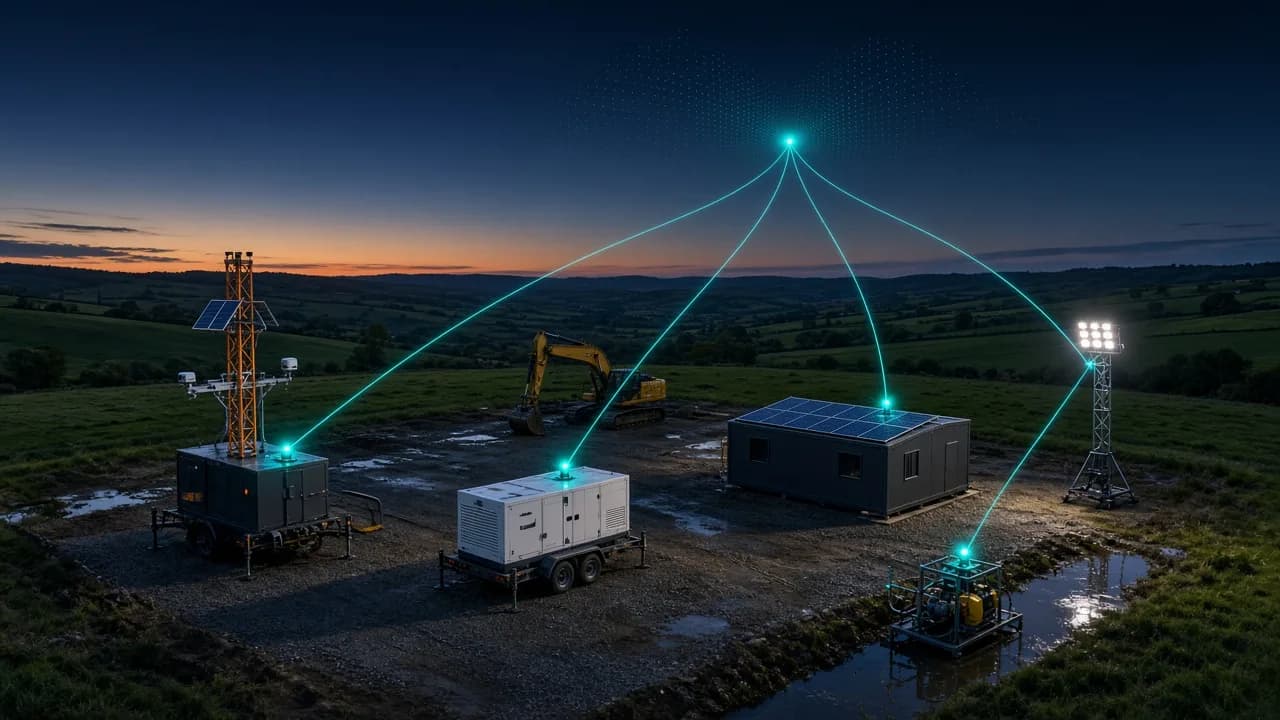
Remote asset monitoring means checking the condition of equipment in the field — its power, batteries, location, connectivity and alarms — over a network, without sending someone to look. TrackSyte® does that for CCTV towers, generators, hybrid power units, pumps, perimeter systems and construction plant, in one portal.
A small gateway on each asset reads the equipment already fitted, sends the data over cellular or Ethernet, and the TrackSyte Portal raises an alert when something needs attention — so engineers go to real faults, not routine checks.
What is remote asset monitoring?
Remote asset monitoring is the continuous collection of operating data from equipment that sits away from your base — on construction sites, roadsides, farms, utility sites or customer premises. A device on the asset reads values such as battery state of charge, fuel, running hours, temperature, location and alarm status, and sends them to a central system where your team can see every asset at once.
The point is to replace routine check visits with live information. Instead of driving out to see whether a tower still has power or a pump is still running, you look at the portal — and only send someone when the data says there is a real problem.
| What is monitored | Typical source | Why it matters |
|---|---|---|
| Battery state of charge, voltage and current | Victron, Smart Shunt or a lithium battery's BMS | Spot a battery going flat before the equipment shuts down |
| Solar, fuel cell and generator charging | Victron, EFOY or the generator controller | Know whether charging is keeping up with the load |
| Fuel level and running hours | Generator controller or CAN bus (J1939) | Plan refuelling and servicing on real data |
| Location and movement | GNSS receiver in the gateway | Find equipment and know when it moves out of hours |
| Alarms and fault codes | Controller, CAN bus, Modbus or digital inputs | React to real faults rather than routine checks |
| Connectivity and device health | The gateway itself | Know a site is reporting before relying on it |
How remote asset monitoring works
Every remote asset monitoring system has the same four parts. The difference between systems is how much of your equipment each part can actually connect to.
- A gateway on the asset — TrackSyte Neo 2 connects to CAN bus, RS485 / Modbus, digital inputs and outputs, Ethernet and Bluetooth equipment, with GNSS fitted as standard.
- A network connection — LTE, LTE-M or NB-IoT cellular for mobile and remote assets, or Ethernet where a site has a network.
- A monitoring platform — the TrackSyte Portal shows every asset on a map and dashboard, with history for each reading.
- Alerts and data access — alert rules send email, webhook or Slack notifications, and MQTT streaming and an API pass the data to your own systems.
Remote assets TrackSyte monitors
Remote asset monitoring pays off fastest on equipment that is spread across many sites, runs on batteries or fuel, and is expensive to visit.
- Mobile and solar CCTV towers
- Perimeter intrusion detection systems (PIDS)
- Generators, hybrid power units and battery storage
- EFOY fuel cell installations
- Pumps, sumps and dewatering equipment
- Construction plant and mixed hire fleets
- Welfare units, lighting towers and remote cabinets
Remote asset monitoring vs GPS tracking and SCADA
Remote asset monitoring overlaps with two older categories, and buyers often compare all three.
| GPS asset tracking | SCADA | Remote asset monitoring | |
|---|---|---|---|
| Main question answered | Where is it? | How is this fixed plant running? | Is it working, and does anyone need to go? |
| Typical assets | Vehicles, trailers, plant | Water works, factories, utilities | Mobile and remote equipment across many sites |
| Data | Location and movement | Detailed process control | Power, batteries, fuel, alarms and location |
| Set-up | Fit a tracker | Engineered system per site | Fit a gateway, connect to the portal |
| Moves between sites | Yes | Rarely | Yes |
Connect the equipment you already run
Most remote assets already have a controller, battery monitor or alarm panel that knows what is happening. Remote asset monitoring works best when the gateway reads those systems directly rather than adding a second set of sensors.
TrackSyte connects to Victron power systems, EFOY fuel cells and Ajax security panels, reads machine data over CAN bus including J1939, and reads Modbus controllers over RS485. Equipment from different manufacturers sits in the same portal, with the same alert rules.
The business case: fewer site visits
The main return from remote asset monitoring is the visits you no longer make. In our illustrative example, a routine visit costs about £197.50 once engineer time, travel, mileage, vehicle and admin are added up — and more out of hours. If a quarter of a team's visits could have been avoided with live data, that is tens of thousands of pounds a year for a small engineering team, plus the downtime avoided when a fault is caught early.
Use the site visit calculator to put your own numbers in.
How to choose a remote asset monitoring system
Before you buy, check:
- Which of your equipment it can read directly — controllers, battery monitors, CAN bus, Modbus — not just location.
- Whether different manufacturers and asset types sit in one portal with one set of alert rules.
- How it connects on remote sites: LTE-M and NB-IoT coverage, and what happens when signal drops.
- Power draw on battery-powered assets, and the supply voltage the device accepts.
- How alerts reach your team — email, webhook, Slack — and whether you can tune them by asset.
- Whether your data can leave the platform through an API or MQTT.
- Who supports it, and where the hardware is designed and built.
Related capabilities and hardware
FAQs
What is remote asset monitoring?
Remote asset monitoring is collecting operating data — power, batteries, fuel, location, alarms — from equipment in the field over a network, so you can see its condition without visiting. TrackSyte does this with field gateways and the TrackSyte Portal.
What is the difference between remote asset monitoring and asset tracking?
Asset tracking tells you where equipment is. Remote asset monitoring also tells you whether it is working: battery state, charging, fuel, running hours and alarms. TrackSyte Neo 2 does both, with GNSS fitted as standard.
Which assets can be monitored remotely?
Anything with a controller, battery system or alarm output that sits away from your base. TrackSyte customers monitor CCTV towers, PID systems, generators, hybrid power units, fuel cells, pumps and construction plant.
How does the data get from the asset to the portal?
The gateway on the asset sends data over LTE, LTE-M or NB-IoT cellular, or over Ethernet where a site has a network. The data arrives in the TrackSyte Portal and can be streamed to your own systems over MQTT or read through the API.
Do I need to add new sensors?
Usually not. Most remote equipment already has a controller, battery monitor or alarm panel. Neo 2 reads those over CAN bus, RS485 / Modbus, digital inputs or Bluetooth, and integrates directly with Victron, EFOY and Ajax.
How are alerts sent?
You set alert rules for the whole fleet or for individual assets, with critical, warning and information levels. Alerts are sent by email, webhook or Slack.
Is remote asset monitoring the same as SCADA?
No. SCADA is an engineered control system for fixed plant such as water works. Remote asset monitoring is lighter: a gateway and a cloud portal for equipment spread across many sites, often mobile and battery-powered.
See remote asset monitoring on your own equipment
Book a short demo to see your asset types in the TrackSyte Portal, which of your equipment Neo 2 can read, and the site visits you could avoid.